Thursday, September 7, 2023

Day One - Clarksville, IN to Danville, MO

We left Add-More RV Park in Clarksville, Indiana around 9:25 a.m. and headed west on I-64. Since the motorhome had been sitting still for several months, we decided to make our first stop in Haubstadt, Indiana. The purpose was to get a bath for Dutch Star at Blue Beacon Truck wash. We also added fuel at the nearby Love's. All that was added was 84 gallons of diesel. With a clean coach and full tank of fuel, we continued westward to St. Louis.

I-64 West takes you across the Mississippi River with the Arch to your right. The new Busch Stadium sits so close to the interstate one almost feels like you can reach out and touch it. We crossed the Missouri River west of St. Louis before intersecting with I-70 and continuing west.


Our stop for the night was Lazy Day Campground in Danville, Missouri. We happened on this campground about 10 years ago. In addition to the nice, level, wide sites, some of the unique features of this campground are all the carved tree stumps. My favorite was the carving of the frogs. The Indian face was interesting in that inside the mouth were two baby owls. There were frolicking bears, raccoons, howling wolves. A few of the photos are provided below.


Entrance sign
Entrance sign

Our 2002 Newmar Dutch Star

Frogs on rocks tree stump art

Fancy work done by chain saw

Three, playful raccoons

Wizard of Lazy Day
The Lazy Day Wizard


Tuesday, September 5, 2023

Trip West 2023 - The Map

After two or three years of planning and life getting in the way, we’re off on our big trip west of the Rockies from our home location in the Louisville area. We’re actually leaving from the RV park where we stay when in the area. Its in Clarksville, Indiana just five miles north of the Ohio River.

The goal is to visit several National Parks, Presidential Libraries/Museums, and other interesting points along the way. At some locations we’ll spend a few days. At others it will be for an overnight stop. We’ll turn toward home (the northwest corner of the trip) after the visit to Butchart Gardens in Victoria, BC. We’ll also be able to visit a some friends along the way.

The 7,000-mile trip will take 62 days. The route is shown in the photo.

Our Trip West for September and October 2023

To be a virtual traveler with us, just check back every day or two to view photos and descriptive text. We'll be glad to have you join us.


Sunday, January 27, 2019

First Half of Winter Break: 10/6/18 to 1/5/19

Our time in Louisville at Ad-More Campground is always enjoyable though a bit short in some respects. For sure, the fall weather was a bit cooler than normal on several days. Being in our home area allowed us to catch up on visits with a few friends as well as Jeremy, Jody, and Candice.

Since we had never been to West Baden and French Lick together, we took off one day and decided to sightsee in the area. Byron had been at the hotel in West Baden around 1981 and he was especially wanted to see the hotel in it’s restored state. At that time it was being used by Northwood Institute as a training center for their culinary and hospitality programs. The hotel itself, however, had fallen into a state of disrepair.

The dome of West Baden Springs Hotel as photographed in the fall.

At the time it was built, the dome of the hotel was the largest
in the world in terms of height from ceiling to floor and
radius from the center to the outer walls. Much of the
terrazo tiles that covered the entire floor has been
covered by carpet. The floor suffered a large crack
before the hotel’s initial closing as a business in the 1940s.

We arranged to meet Larry and Peggy Stahl who live near Danville, Illinois. We enjoyed a great lunch together at one of the restaurants frequented by Larry Byrd (in the day) and took a ride on the French Lick Scenic Railroad.

This is actually a composite photo. Martha took one photo and
then Byron took another. All that was left to do was move
Byron’s image onto the photo taken by Martha. Larry and
Peggy just had to stand still and hold a smile.

The“Scenic Railway” is, in reality, not too scenic. After all,
railroad were sources of noise and polution and ran through
the back yards of many people. That the trees were not
in their fall prime was also not a help.

As many of you know, we began our fulltiming journey on July 1 or 2014. As we passed from 2018 into 2019 we began our fifth season at what has become our winter base, Great Oak RV Resort in Kissimmee, Florida. In conjunction with this, Byron began his fifth season at Walt Disney World working at Casey’s Corner or Tomorrowland Terrace as Martha began her fourth season at Chick-fil-A in Celebration, a Disney-designed community just south of the WDW complex. Also, we are always happy to return to First United Methodist Church where Byron takes on the teaching role of the Hugh Embry Sunday School Class.

Since Byron gets complimentary tickets to the parks, we took advantage of the opportunity to go to EPCOT for an early dinner at the Rose and Crown. After having fish and chips (Martha) and shepherd’s pie (Byron) we went to our sixth annual performance of the Candlelight Christmas Processional. We think this will do us for a while since the program is the same from year to year. The only thing that changes are thee narrators. This year, we heard Pat Sajack from Wheel of Fortune.

A performance of the Candlelight Christmas Processional. The tradition
of the program was initiated by Walt Disney himself with the first
performances being at Disneyland. When Walt Disney World opened,
the program became an annual activity for EPCOT.

The choral music program features a choir and orchestra of auditioned Disney cast members plus local high school, college, and church choirs. The program is presented three times each evening from the middle of November to December 31.

Every Disney property has a castle as the focal point of
the Magic Kingdom. Each castle at each property is
different in some way and named for a different
Disney princes. This is how the Cinderella Castle
looks in the early evening light when decked out
for the Christmas season.

Our travels were somewhat restrictive this year. We went from the Kentucky end of I-64 to it’s extreme eastern point at Virginia Beach where we spent the summer. Of course, we tend not to take one of two paths to Central Florida from our Louisville haunts.


We’ll get back to the blog again in April when we begin our trek northward through Louisville to Henderson, New York. We’ve contracted to work at the 1000 Islands/Association Island KOA on the edge of Lake Ontario.

Saturday, October 6, 2018

Virginia Beach and Beyond – 08/05 to 10/05

We completed our work commitment at Virginia Beach KOA Campground after Labor Day as Hurricane Florence started threatening the East Coast. After nearly two weeks of traveling around, we wound up in our home area of Louisville, Kentucky for our annual layover before heading south for the winter.

The Virginia Beach KOA is the largest at which we’ve ever worked as far
as the total number of sites, including tent, RV, Kamping Kabins, and
Deluxe Cabins. Shown here is a family enjoying dinner the
cul-de-sac area of the campground.
These beautiful flowers were on a berm between the front door of the
campground store/office and the swimming pools.


As we moved through August, we continued to experience heat and humidity in keeping with being near the beach. We did venture out on one warm day to visit the last item on our summer “to do” list: The Military Aviation Museum.

This museum is home to one of the largest private collections of military aircraft that date as far back as World I. The most amazing thing about this place is that nearly all of the planes are airworthy and flown either at the museum during flight demonstrations or at airshows. One can even schedule a flight in one of the planes. The collection was extensive and quite amazing. It consists of the main museum area, which houses planes and other memorabilia, and then another hangar, which houses an extensive collection. A third building is the mechanical workshop where restorations and repairs are conducted. The idea for the museum took developed in the fall of 1994 when the museum’s founder was attending a convention in Hamilton, Ontario. Shortly after returning to Virginia Beach, he started looking for World War II-era aircraft to acquire. The first plane to be restored was a wrecked Curtiss P-40E Warhawk recovered from the Arctic Circle. As they say, the rest is history. They now are displaying seventeen plane from WW I and more than 40 from WW II. Of course, the museum’s holdings increase year over year.

Byron is pictured in front of the Sopwith Strutter, a British aircraft of
the First World War. It was the first British aircraft to 
enter service with a synchronized machine gun.

Martha stand in front of a fully restored B-25J. The WWII bomber
is named “Wild Cargo” (not referring to Martha). The Mitchell medium 
bomber was in the opening months of the war. The entire air bombardment
concept owed itself to Gen. “Billy” Mitchell. The B-25 is 
the only U.S. aircraft to be named after a person.

August morphed into September with the campground winding down to a leisurely pace as travelers returned home. Labor Day saw us quite busy, and then there was Hurricane Florence. Not sure of Hurricane Flo’s exact route and the lack of business, we departed Virginia Beach on September 10th in hopes of finding ourselves out of the path of the rain and wind.

The campground at Virginia Beach looked rather empty
on the day that Florence was to make landfall. Those with
reservations for Customer Appreciation Weekend had
cancelled in fear of being caught by the hurricane.
Had we stayed, there would have been no guests
for whom customer service was needed.

We spent a couple of nights in Lenoir, North Carolina, about 30 miles south of Boone and east of Asheville. However, once we saw all the other guests leaving with their rigs, we decided moving on north and west across the Appalichians into Tennessee might be a wiser choice. We were parked on a creek, back in a holler, and under power lines: nice spot for more casual weather but not for what we could see coming. We decided riding out a flood and the possibility of downed power lines was not our best option. So, we packed up and headed toward the western side of the Smokey Mountains.

Our site at Green Mountain RV Park was nice with a babbling creek
behind and a concrete pad on which to park.

We spent six nights in Sevierville, Tennessee on the banks of the French Lick River at Two Rivers Landing RV Resort. This was, perhaps, the nicest location at which we have ever stayed. The location was 14 years old but well maintained. The price was very competitive. And, we were safe here.

Our motorhome is nestled in between the shrubbery that divide each site at
Two Rivers Landing. Each site is also marked by a crepe myrtle bush.
And, handy to the highway while away from the heavy traffic in Sevierville.

We attended the United Methodist Church on Sunday and heard what churches in the area were doing for expectant mothers on oppioids at Susannah’s House in Knoxville. Other exploits while here took us to eat at the Apple Valley Grill and a day drive into and around Townsend and Cades Cove.

No caption necessary.

From Sevierville, we traveled to one of our favorite parks, Riverpark Campgound on the banks of the Nolichucky River in Jonesborough, Tennessee for a visit with Byron’s brother and sister-in-law, Lewis and Marcia Songer.

On the banks of the Nolichucky south of Jonesborough, Tennessee.

After dinner in the refurbished area of downtown Johnson City, Tennessee.

After our visit with Lewis and Marcia, we spent one night at Bean Pot Campground in Crossville, Tennessee before moving on to Diamond Caverns Campground just inside Mammouth Cave National Park. While there we took a the 2-hour Domes and Dripstones tour seeing a very small portion of the 412-mile cave system known as Mammouth Cave.

The Domes and Dripstones Tour ends in an area of Mammoth Cave,
one of the dying-cave sections. This is where the
stalactites and stalagmites are formed. To us, it isn’t dying.
However, our ranger and guide presented a good
explanation as to the meaning and the
differences in the cave environments. 

While in the area we went to the National Corvette Museum in Bowling Green. Yes, the vehicles recovered from the sink hole colapse several years ago are on display along with many other Vettes spanning the history which began in 1953.

There are a vew “period” areas of the museum in which some
of the vintage Corvettes are shown. A 1958 model is shown in this image.

As we recall, there were five of the damaged Vettes on display.

Upon checking with our “home” campground, we found that we could arive two days earlier than planned since they had a few cancellations. We headed for Add-More Campground in Clarksville, Indiana on Saturday, September 29. Now we can catch-up with friends and family before moving onto Florida for our winter jobs and taking some opportunities to visit with our grandchildren and daughter and son-in-law, Michael and Ashley.

Wednesday, August 15, 2018

Fourth Month in Virginia Beach - 07/04 to 08/04

Welcome back (if you’ve been on our Blogspot before). Or, welcome (if you’ve not been here before).

As the title of this entry states, it is our fourth month in Virginia Beach. Though we haven’t seen all there is to see within a 75-mile radius, the rain has slowed us down a good bit. July was a very wet month for the area and the wettest in weather history. August it, typically, the wettest month in the year for Virginia Beach.

For July 4 the KOA had an Independence Day parade. Shown here
on a rental unit is one of our co-workers. Brianna is from Texas
and her husband was stationed here for a while. Sadly, they
have moved on and left the campground. This photo just
shows a bit of Brianna’s joyful spirit.

Having displayed one photo (above), we’ll show some others so you can get a look around the KOA where we’re working as “Work Kampers” (a KOA term) for the summer.

This is the official image of the campground map for 2018. We are parked
In the Extended Stay area of the campground (#521 on the lower left) which
is separated from the itinerant portion of the park (the rest of the campground).
It is a long walk from our motorhome to the store we work out of (upper right).

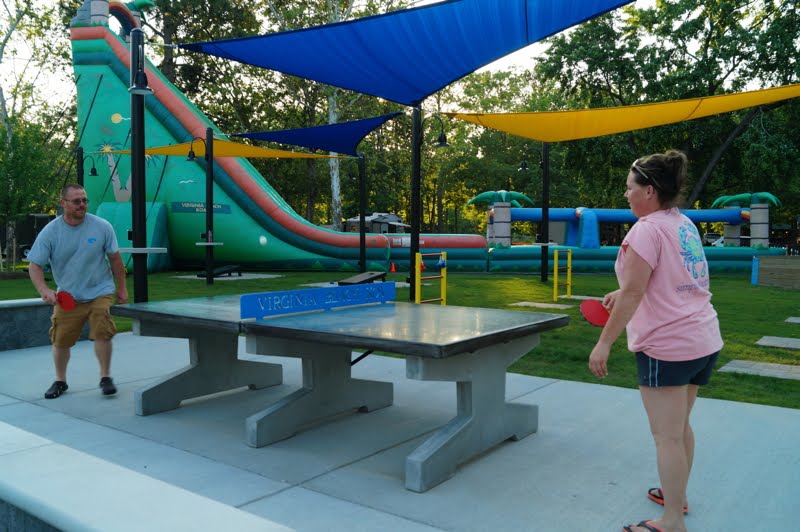
New to the KOA here in Virginia Beach is something called a “pocket park”
where there are several game areas. The photo shows the permanent ping-pong
table (the table surface is manufactured granite and quite heavy).
There is also bocce ball, gaga ball, horseshoes, bolo toss, chess, and
other game areas. In the background you see the blow-up slide.

The inflatable slide is quite popular here. During the summer it is open
for one hour, three times a day. Around here it has the nickname of
“Wedgie” for which the managers have created a photo contest.

Nearly every KOA now has cabins available. There are the basic
Kamping Kabins (as shown here) and Deluxe Cabins which
offer self-contained bathrooms and kitchenettes. Most of
the basic cabins here in Virginia Beach have been located in
a wooded area. Each has air conditioning (not all Kamping Kabins
in other campgrounds have air conditioners or concrete patios).

When it rains, it pours -- and can get muddy. Shown above is a tent
that survived a storm but not the deluge of water.

As mentioned in a previous blog, this is the largest campground in which we have worked. More than one-half of the summer staff is made up of local employees though there are twelve of us who are working campers. Martha works in the store handling registrations and sales of store merchandise. Byron works outside escorting guests to their sites, cleaning the sites before arrivals or after departures, and delivering firewood or ice when requested. At present, our plan is to leave here in the middle of September and work our way back to home base in the Louisville area after a couple of weeks “on the road”.

Now, for the things we’ve managed to see when it hasn’t been raining.

Our first trip was to the American Revolution Museum in Yorktown. This museum is owned by the same organization that operates Jamestown Settlement. (We’ve learned that most attractions in the area are commercial establishments and not operated by the National Park Service or state government). The building, in which most of the displays reside, is only a few years old just as was the case at Jamestown Settlement. This time, we knew to go through the display gallery in chronological order. We did it backward at Jamestown.

The focal center of the American Revolution Museum is impressive and
rather new. The building is based on the architecture of the period with
Large display halls on either side of the main entrance.

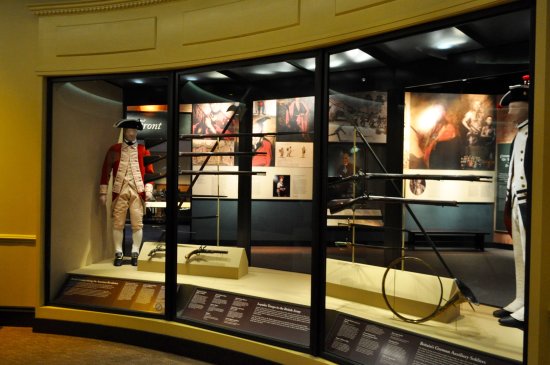
Shown here is a display of uniforms of officers and small weapons
used during the period. The displays are well and offer several
viewing angles.

Of course, a modern museum will have some type of media display. Shown
here is the small theater that covers the Seige of Yorktown by the British.
The British attacked from ships on Chesapeake Bay while the
soldiers of the revolution fired on them from canons placed
above the hilly coastline.

Many of the displays also feature art and artifacts as well
as other material related to the Revolutionary War period.

For the outside display, the museum has recreated an encampment and
small village typical of the time.

This is what a the mess area and the food would have looked like 
during the Revolutionary War. Anyone for KP duty?

No visit to a museum about the Revolution would be complete
without some type of tribute to George Washington. Shown here is
a marble statue displayed under a small rotunda in a separate room
paying tribute to Washington.

The Hampton History Museum and the Carousel was the next afternoon adventure. It wasn’t particularly thrilling. It was just included in our multi-venue ticket we had purchased in June. To get our money’s worth, we returned for these.

The Hampton History Museum is, after all, about the history of Hampton which includes the city’s early inhabitance by the Kecoughtan tribe and contributions of African-American residents. Ten permanent galleries span Hampton’s settlement to the city’s role as the founding site for the U.S. space program (NASA at Langley Field). The galleries show a narrative beginning with the Virginia Colony and continue through phases of Coastal Virginia life which includes Blackbeard the Pirate. The burning of Hampton during the Civil War as well as the Contraband decision (the first step toward freedom for millions of African-Americans) is also depicted. The museum shares space with a gift shop and the Hampton Visitor Center.

An original fire apparatus is on display in the Hampton History Museum.

Across the street is the carousel that his housed in its own pavilion.
The band organ for the carousel isn’t played regularly
but appropriate carousel music is.

Selfie on a Carousel — how is that for a title?

Hampton’s Carousel is a whirling tribute to the skill of its creators. It still has its original mirrors and oil paintings, as well as 48 intricately decorated horses. Hampton’s restored 1920 merry-go-round is an interesting attraction for the city’s downtown waterfront. One of only 70 antique carousels still in the United States, the Hampton Carousel is a rare and beautiful example of American folk art. The horses and chariots were originally painted by German, Italian and Russian immigrant artisans.

Our final trip of the month was to the fantastic Mariners’ Museum in Newport News. It is about a seventy-five-minute drive from the KOA in Virginia Beach. So, once again, we headed out on I-64 through the tunnel-bridge one gets used to traveling in the Hampton Roads area (the designation for the body of water connected to Chesapeake Bay).


A visit here is one of the “must see” attractions for the area. The mission statement is: “The Mariners’ Museum and Park connects people to the world’s waters, because through the waters—through our shared maritime heritage—we are connected to one another.” The museum carries out that mission quite well.

The meticulously carved Eagle figurehead from the USS Lancaster
is situated inside the main entryway of the Museum. It has been restored to its
original glittering finish with a wingspan of eighteen feet and weight of 3,200 pounds.
When the US Navy was rebuilding the frigate in 1880 (adding steam),
they commissioned the object paying the artist $2.32 a day
to carve the enormous Eagle.

The museum was originally founded in 1930 by the son of a railroad and shipbuilding magnate, Archer Huntington, and another gentleman who was head of Newport News Shipbuilding at the time. They provided the basis on which a great museum has been made. Now in a relatively new home within a city park, the museum provides a comprehensive glimpse at how the people who made up sea travel and shipping provided us with a great foundation.

The 17,500 square foot facility houses a collection that features nearly 150 boats from 42 countries and is one of the few internationally focused collections in the world. A primary feature of the museum is The USS Monitor Center.

A view inside the building where small boats from 42 countries are displayed.

Just inside the entrance to the museum, one sees the large wall with
a scale drawing of the plans for the USS Monitor, one of the
ironclad ships that were instrumental in making a fundamental
change to how future navies would do battle.

One might wonder why all the emphasis on the USS Monitor and not an equal emphasis on the former USS Merrimack (renamed and refurbished as the CSS Virginia when under Confederate command). There is likely one, big reason. Though both ships later sank after their initial confrontation, it was the Monitor that was discovered and raised on August 5, 2002, nearly 140 years after the sinking of the historic, Civil War ironclad. In fact, Monitor’s turret was raised 240 feet from the depths of the Atlantic Ocean off Cape Hatteras, North Carolina and taken to the museum where it has been engaged in a desalination process that will take many years.

As can be easily seen in this photograph, the crew’s quarters, engine room, and
store for the artillery were below the deck which rode just a couple of feet
above the water line. The only thing sticking above the water line of any
significance was the turret which housed only two guns mounted
on a rotating base. The base, however, was constantly turning
to make the taking of aim very difficult. Still, the ironclad was
able to inflict as much damage as it escaped or repelled.

This is a full-scale representation of the condition of the turret when
first discovered earlier in this century. The rusting caused by the
ocean's water and other debris has had an effect on the iron.

The replica, above, is shown at full scale. The two, XI-inch Dahlgrens
(canons) were constantly in rotation. One of the crew members noted
that, when under attack, it became difficult to tell when a canon
was actually pointed in the correct direction since it was always
moving (in relation to the ship) with smoke in the turret
becoming so heavy and thick. “Which way is starboard?” It became
difficult to define so firing on the CSS Virginia was more of
a calculated guess than anything based on dead reckoning.

Also on display is a full-sized mockup of the forward one-half of
the CSS Virginia. In the foreground is a scale model of the ironclad
ship. Layers of iron were placed above a base of thick lumber with
the lumber serving as a cushion. The raised hull of the sunken frigate,
USS Merrimack, was used as the basis for the Virginia.

Though the iron superstructure helped in deflecting cannonballs or other projectiles, the ship was still hard to maneuver compared to the smaller Monitor. Virginia was also designed for standard naval battle which called for pulling parallel to an opposing ship and firing until a boarding party could take the enemy ship and carry on with hand-to-hand combat.

The Battle of Hampton Roads, however, was not a typical battle between opposing ships. The design of the Monitor enabled it to fire from nearly any position and not just from the side. Not only did the canons spin on an axis, but they could be raised or lowered. Compare this design to the guns of the Virginia (which had more than the Monitor) and one begins to see how “less is more” really did apply in this situation.

Since photography was still in its early stages of development, only
paintings could be made to capture how the battle may have looked.
Interestingly, each ship pulled away from the other which brought
about the end of the battle in which neither side had really defeated
the other. The decisive thing was naval warfare would now be fought
from ironclad ships with large guns mounted on rotating turrets.

Though this entry in our blog has been lengthy, we do hope you found it interesting and educational in some way. For sure, we have witnessed a fascinating view of the history of both Colonial America and Civil War America. The good thing to know is that it is still the United States of America and that we get to explore some of it each summer.